
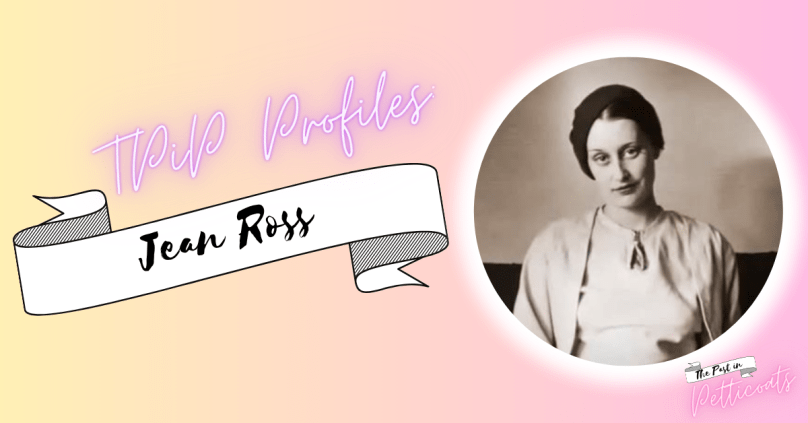
TPIP Profile #8: Jean Ross, Far From Fiction 

Name: Jean Iris Ross Cockburn 

Born: 7th May 1911

Died: 27th April 1973

Country of Origin: England, UK 

In a nutshell: Best known as the inspiration for the apolitical and hedonistic Sally Bowles in the novels of Christopher Isherwood and the musical Cabaret, Jean Ross’ wild life took her from the Berlin cabaret clubs of the Weimar Republic to the war-torn streets of Madrid as a correspondent. 

***********************************

Have you seen the musical Cabaret or read the novels of Christopher Isherwood? Maybe you’ve heard Liza Minelli belting the title track as the Kit Kat Club’s Sally Bowles? Did you know Sally Bowles was based on a real person? This was author Christopher Isherwood’s friend, the then 19 year-old Jean Ross. When she was living in Berlin she worked as a cabaret club singer before the political situation in Germany made her and her bohemian circle up and leave. But, this is only the start of the life and times of Jean Ross so let’s take a deeper look into this often misrepresented figure. 

Born in Egypt in 1911 to British parents, Jean Ross left Africa to be brought up in England. She was a vastly intelligent but often bored child and hated school. At the age of 16 she pretended to be pregnant so she would be expelled. Her parents then sent her to a Swiss finishing school but Jean went rogue and enrolled into the Royal Academy for Dramatic Art before dropping out, getting a small part in a movie and moving to Berlin to pursue an acting career. 

At this point in history, the Weimar Republic led Germany. This was the German government from the end of the First World War in 1918 to the accession of the Nazi party in 1933. This period was one of cultural and artistic revolution but also of hyperinflation and mass unemployment due to the war and the Great Depression. Whilst working as a cabaret singer and small-time actress in Berlin in this unsettled Germany, Jean Ross met British-American author Christoper Isherwood, a man who would have a huge impact on her life. 

Isherwood had been drawn to Berlin to explore the night life, especially the gay clubs and cabarets. After their first meeting, in which Jean Ross spoke openly about her sexual conquests, they became close friends and began living together. Through her connection to Isherwood, Ross became familiar with many other gay male writers in Isherwood’s circle of friends. 

It was around this time that Ross entered into a relationship with actor Peter van Eyck but soon they parted and Ross discovered she was pregnant. Isherwood helped her get an abortion but due to complications, Ross spent time in hospital recovering from what turned out to be a botched abortion. Through this time, the poverty in Germany and Hitler’s influence in the local attitudes towards minorities, Jews in particular, was turning Ross and Isherwood’s beloved Berlin into a much darker environment, though it took them time to see it. Ross left Germany for the UK in 1932. Isherwood stayed a while longer due to his relationship with the German Heinz Neddermeyer but after Hitler was appointed chancellor in 1933, he and Neddermeyer followed Ross. 

Back in London, Ross began work as a theatre and film actress, model and reporter. The latter of those roles was secured through her relationship with communist journalist Claud Cockburn. He greatly influenced Ross’ political leanings and helped her get a job writing for left-wing newspaper the Daily Worker. Not forgetting her friends though, Ross used her connections in the British film industry to help both herself and Isherwood get jobs as translators. Isherwood would soon thrive in the film industry but also turned back to writing novels. He revisited his diaries from his time in Berlin and wrote a novella called Sally Bowles inspired by his friends and experiences from the Weimar Republic. It was apparent though that Sally Bowles was very much inspired by Jean Ross, especially as her abortion appeared as a scene in the book. Ross was initially reluctant to give Isherwood permission to publish the novella due to abortion still being illegal and a taboo subject in Britain at the time but eventually she relented and Sally Bowles became a huge hit. 

Ross continued her work in the film industry by writing film criticism in the Daily Worker and even serving as the General Secretary of the British Workers’ Film and Photo League which sought to make films with an anti-capitalist focus. 

Things soon changed again for Ross when she starting working in Spain as a war correspondent during the Spanish Civil War. She worked there with Cockburn and her lover John Cornford until Cornford died fighting as part of the Spanish communists’ militia. Over the next few years, Ross worked as a war correspondent for the Daily Express. She remained in Spain despite the bombings and often reported directly from the front lines. She witnessed the Siege of Madrid and returned to England just two months before giving birth to her daughter Sarah by Cockburn. Cockburn left Ross and their daughter for another woman just three months later.

Ross moved to Hertfordshire with her mother and daughter and devoted herself to raising Sarah whilst never losing her strong socialist opinions. She died in 1973 from cancer. 

It was only after Ross’ death that Isherwood finally confirmed Sally Bowles had indeed been based on Ross. Sarah Caudwell, Ross’ daughter, wrote an article in 1986 shedding some light on how Ross truly felt about the connection. The article shares how Ross felt frustration over the fame the portrayal gave her, how journalists wanted to know about her sexual exploits and not anything about the work she had done in her political and journalistic career. Understandably so, whether you agree with her political stance or not, you can’t argue that, though Sally Bowles is a fascinating character, every moment of Jean Ross’ life following her departure from Berlin shows her to politically-driven and deeply concerned for the welfare of others, two traits that you don’t see in Sally Bowles. In fact, there is some reason to believe that Isherwood, with all the success and fame, was perhaps projecting his own lack of understanding of the political climate in 1930s Germany onto Sally.  

In Sarah Caudwell’s article she said that her mother “may well, at 19, have been less informed about politics than Isherwood, five or six years older; but, when the Spanish war came and the fascists were bombing Madrid, it was she, not Isherwood, who was there to report it.”… which seems to sum up the situation pretty well. 

Thanks for reading!

*Image sourced through Wikimedia Commons

TPIP Profile #7: Evelyn Nesbit, From Rags to Riches to the Witness Stand

Name: Evelyn Nesbit

Born: 25th December 1884 (possibly 1885)

Died: 17th January 1967

Country of Origin: USA

In a nutshell: Both a model and actress, Evelyn is best known nowadays for her involvement in the murder trial of Stanford White. But, even before being rocked by scandal, her face was one of the best-known of her day. 

*Trigger warning: Sexual assault 

***********************************

In January 1907, a court case began which the press of the time called ‘the trial of the century’. Evelyn Nesbit would have been around 22 years old when she appeared as a star witness. She told the court about how she had been sexually assaulted by the architect Stanford White. At the turn of the century, it was still rare for accusations of sexual assault to be shared in court. However, this wasn’t the crime that had brought Evelyn to the witness stand. She was to give evidence in defence of White’s murderer, her husband, Harry K. Thaw. It was a complicated and highly publicised case that would lead to Evelyn’s cataclysmic rise to fame to take a dramatic turn.

Evelyn was born around 1884 in Pennsylvania. Her exact year of birth is unknown, Evelyn herself even said she wasn’t sure due to the records being lost in a fire and her mother, Evelyn Florence, possibly changing her year of birth depending on the requirements of child labour laws at the time. She grew up with a love of books and learning but her father, an attorney, died when Evelyn was 10 and the family fell into poverty. 

Evelyn, her mother and younger brother moved around for a while before settling in Philadelphia and all three of them got work in a department store. One day, when Evelyn was about 14, she was spotted by an artist who asked Evelyn to pose for her. This was Evelyn’s first introduction into what was to become her profession. The family then relocated again, this time to New York and soon enough Evelyn was posing for various high-profile artists of the time. Possibly the most notable of these was James Carroll Beckwith, whose patron was none other than millionaire John Jacob Aster. 

Evelyn’s mother was thrown into the role of manager for her daughter as she became more and more in demand. She transitioned easily from the star of portraits to the star of photographs and became a renowned fashion model. She starred in advertising campaigns and soon got a role as a chorus line girl in the Broadway play, Florodora. It was around this time that rising star Evelyn was introduced to Stanford White. He was an architect known for working on various big projects, including the second iteration of Madison Square Garden. White and Evelyn began spending time together and he lavished her and family with expensive gifts and paid for their accommodation. Evelyn was already the subject of much press attention at the time and stories circulated about their relationship. One story that became particular popular was that White had a red velvet swing hanging from the ceiling of his apartment that he had allegedly pushed Evelyn on during her first visit to his place. The press would later give her the nickname ‘the girl in the red velvet swing’. During this time, Evelyn would have been around 16, White was in his late 40s.

After a while, Evelyn and White’s relationship came to an end and she became associated with other men, including the millionaire Harry K. Thaw. This was during the time when she took on a speaking role in the play, The Wild Rose. Thaw and Evelyn married in 1905 and they relocated to quiet Pittsburgh. 

It was what happened next, during a visit to New York, that would dominate any mention of her name in history from this point on. At a performance at the Madison Square Garden rooftop, Thaw shot White dead at close range. 

In court, Thaw pleaded temporary insanity, claiming that he was acting in defence of his wife who had been raped by White. Evelyn was even brought forward to take the stand and she shared the story of what had happened to her at the hands of White in detail. The media of the time were completely absorbed in the ‘crime of the century’ and for the first time in US history, the jury had to be sequestered. Eventually, Thaw was found not guilty and was interned in a psychiatric hospital rather than a prison. 

Evelyn was supported through the court proceedings by Thaw’s family but once the trials were done with, they cut her off financially and Evelyn made her own way through work as a vaudeville star and silent film actress. She had a son called Russell in 1910 who she claimed with Thaw’s child after his conception during a visit to where Thaw was hospitalised. Throughout the rest of his life, Thaw would deny paternity. 

Thaw was let out of from hospital in 1915, the same year that Evelyn divorced him. Not long after, Thaw committed violent and sexual abuse of 19-year-old Frederick Gump and, after another plea of insanity, was placed in an asylum. 

For a time, Evelyn was married to her dance partner, Jack Clifford, but the marriage was short-lived as he couldn’t handle her fame. Evelyn would struggle with finances and addiction for many years. She worked as a technical advisor on a highly fictionalised film about her life, ‘The Girl in the Red Velvet Swing’, released in 1955 and died in California in 1967. 

Evelyn is also featured in the book, musical and film, Ragtime. 

Now you’ve read her story, what do you think? Was Evelyn a fame and money-hungry queen of scandal and ‘girl in the red velvet swing’ or a mistreated teenager and abuse survivor who had to grow up too fast to support her family? You decide. 

TPIP Profiles #2: Enheduanna (Poet, Princess and Priestess)

Name: Enheduanna

Born & Died: 23rd Century BCE

Country of Origin: The city of Ur in modern day Iraq

In a nutshell: Enheduanna was a poet, princess and priestess whose particular claim to fame is being the writer of the oldest texts by a named author in world history. That’s kind of a big deal, right?! 

************************************

Enheduanna lived in the city of Ur (in modern day Iraq) in Mesopotamia all the way back in the 23rd century BCE. That’s an almost mind-bending length of time ago so what makes her iconic enough for her name to have made it through the centuries to now? Well, here’s a little known fact. The oldest texts by a named author in history were written by a woman. I can’t be the only one a little bit chuffed about that!

This woman was Enheduanna, a poet, princess and priestess of the Akkadian Empire and from all those alliterative jobs she had (in the English language anyway), it’s clear she was a busy woman. Or, at least, I’m pretty sure she’d qualify as a #girlboss by today’s standard. 

Enheduanna was the daughter of King Sargon of Akkad, the first leader of the Akkadian Empire and possibly the world’s first ever emperor so this pretty epic girl had a pretty epic lineage. Little is known of her family life or childhood but what is known is that she was given a place of great honour in her position as high priestess of the cult of Nanna. Both patron to the city-state of Ur and god of wisdom, Nanna was a moon deity worshipped in Mesopotamia. However, Enheduanna’s poems show a particular devotion to Nanna’s daughter Inanna, goddess of love, beauty, sex and war. For reference, the Greek equivalents of Inanna are thought to be a combination of Aphrodite and Athena. 

Enheduanna’s position as high priestess continued through the reigns of her brothers Rimush and Manishtushu. However, one of her poems, The Exaltation of Inanna, details her enforced exile by someone known as Lugalanne, a possible enemy of her nephew Naram-Sin. I need to pause to tell you a little bit about Naram-Sin as he is an odd figure in history. He is considered the ruler of the Akkadian Empire when it was at its strongest and defied himself so that he not only held the title of king but also god of the four corners, as in the four corners of the world… essentially Naram-Sin classed himself god of the entire world. Aim high, I guess. 

Back to Enheduanna though as we need to talk more about her writing. She wrote several poems and 42 hymns and these had such a lasting impact that she practically set the bar for religious writing, and just about any writing really, for centuries to come. Some even believe the her lasting influence can be found in the Old Testament and the writings of Homer. 

All knowledge of Edheduanna seemed lost to time until 1927 when British archaeologist Sir Leonard Wooley discovered a disk that held both Enheduanna’s name and a carving of her likeness. I’d love to tell you more about one particular member of Sir Wooley’s excavation team, his wife, Katherine, who inspired an Agatha Christie character, but that’s a story for another time. 

As both high priestess, an incredibly powerful and respected position for her time, and poet, Enheduanna made her lasting impact on history. It’s also worth noting the impact she had on literature. The very first uses of written language date way back to ancient Mesopotamia three thousand years BCE. However, the written word came in the form of note taking for the merchants of the time to keep track of their finances and dealings. Enheduanna was the individual that took written language away from being a tool of necessity and turned it into a means of self-expression and worship. So, to answer my own question from the beginning, yeah, Enheduanna and her impact on literature is definitely a big humungous deal.

Thank you for reading. Just a little disclaimer that I’m not very familiar with the history of Mesopotamia but I’ve done my best with researching on this because it was a story too good not to tell. If any of the facts are a little off, please feel free to let me know. For more info on Enheduanna and her influence, check out this amazing TED-Ed video.