
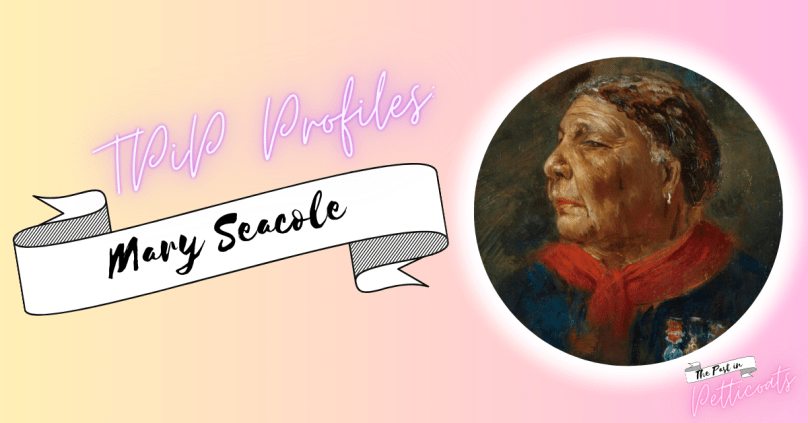
Name: Mary Seacole
Born: 23rd November 1805
Died: 14th May 1881
Country of origin: Jamaica and England, UK
In a nutshell: Mary Secole was a nurse with an epic drive to help others. She is best known for her time as a war nurse on the frontlines of battle and for turning her incredible life into a Victorian bestseller.
***********************************
Mary Seacole was a healer with plenty of bottle. From working with the sick in a cholera epidemic to healing on the frontlines of war, Seacole certainly wasn’t afraid to do what was necessary (and then some!) to help others. She is best known now for her time as a nurse in the Crimean War though she’s not usually the nurse people tend to most closely associate with this particular conflict. Whilst Florence Nightingale did some wonderful things for nursing and we’ll definitely tell her story at a later point, I want to put Mary Seacole first because more people need to know her story.
Seacole was born in Kingston, Jamaica in 1805. Her father was a white Scottish lieutenant and her mother was a black boarding house manager. At this point in history, slavery had yet to be abolished but she was born into ‘freedom’ which meant her rights were still greatly restricted as a mixed race woman. As a child, Seacole developed a love of medicine from her mother who was known locally as ‘The Doctress’. She practised Jamaican folk medicine on her dolls and pets and met many injured soldiers from helping at her mother’s boarding house. Soon enough, she was heading on a career path in nursing and took a trip abroad to learn more.
She travelled to London, Haiti, Cuba and the Bahamas and developed her medical knowledge more and more along the way. After returning to Jamaica in 1826, Seacole went on to meet her husband Edwin Horatio Hamilton Seacole and the two married in 1836. However, Edwin became ill and despite Mary’s nursing, he died only years into their marriage. Her mother died not long after and Seacole suffered greatly with the grief.
She was still in Jamaica when the cholera epidemic came and she began treating sufferers at her mother’s boarding house, revamped due to a fire. In 1851, Seacole travelled to Cruces in Panama and the cholera epidemic followed. She treated the cholera victims in the area until eventually catching the illness herself. She recovered and returned to Kingston in 1853 where she began treating those with yellow fever. It was during this time that Seacole was asked to treat the soldiers at Up-Park Camp, British army headquarters in Jamaica.
News soon reached Seacole of the outbreak of the Crimean War all the way in eastern Europe and she felt compelled to help the injured soldiers. She travelled to Britain once again and asked the Home Office if she could be enlisted as an army nurse but was denied. In her autobiography, Seacole herself questions whether her rejection from both the Home Office and the Crimean Fund, a fund-raising campaign to support the injured troops, was down to racism. However, Seacole was determined to help those in need and be reunited with her ‘sons’, the British soldiers she’d healed previously, and she funded her own trip to the Crimea. When she got there, she developed the British Hotel with her late husband’s relative, Thomas Day. The hotel treated the sick and wounded close to the frontlines and news of her kindness and bravery made its way back to British shores.
Despite her fame, Seacole returned to Britain at the end of the war practically penniless. However, those she had saved weren’t so quick to forget her good deeds and countless letters were written into the media of the time thanking her for her care and donations started coming in to support her financially. She also generated funds from her autography, The Wonderful Adventures of Mrs Seacole, a bestseller of the time.
Seacole moved back to Jamaica for a short while before settling in London. She had friends in high places at this time and even had a bust created of her by Queen Victoria’s nephew. She died in 1881 and her name fell into obscurity for many years. Her story has been given much more love and attention in recent times as more black and mixed race history is brought into the spotlight. A statue of her was placed in front of St Thomas’ Hospital in London in 2016.
To learn more about Seacole, visit the Mary Seacole Trust website. Thank you for reading.
Credit to the National Portrait Gallery for the Mary Seacole portrait (painted by Albert Charles Challen)
 The Past in Petticoats