
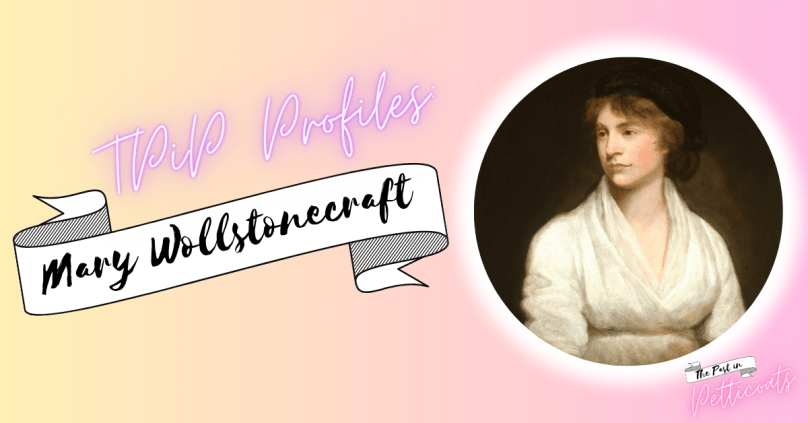
Name: Mary Wollstonecraft
Born: 27th April 1759
Died: 10th September 1797
Country of origin: England, UK
In a nutshell: Mary Wollstonecraft is one of history’s best-known proto-feminists. As a writer, she is most famous her publication, A Vindication on the Rights of Woman 🙌
***********************************
‘I plead for my sex, not for myself’
When you learn about the lives of women in the past, it’s not hard to see how early feminist ideas were starting to ignite, even decades before the first women’s suffrage movement. One of the first epic rally cries for gender equality was committed to paper fearlessly by arguably the best-loved and most renowned proto-feminist in Britain, Mary Wollstonecraft.
Wollstonecraft was no stranger to inequality. Even as a child, she saw the unfairness in her brother being able to attend school full-time while her education wasn’t a priority for her family. She was determined to learn though and by the time she was 25, she had co-founded a school for girls in London. Unfortunately, the school was short-lived and closed after the death of her co-founder and good friend, Fanny Blood. She then found work as a governess for some time before making it as a writer.
Although her experience at the school hadn’t lasted, it did lead to the first of Wollstonecraft’s bold treatises, Thoughts on the Education of Daughters. Wollstonecraft was a keen advocate for gender equality in education and firmly believed women were just as intelligent as men. She even claimed that her theory could be proven if men and women were given the same lessons. Her work saw her gain a place among some of the great thinkers and writers of the Enlightenment and during this time she thrived, both from her new-found circle of friends and from the sea of change gripping Western Europe and North America. The French Revolution was a hot topic in the UK, as was US Independence. Not everyone was a fan, however. Edmund Burke, an Irish politician and writer, wrote his Reflections on the Revolution in France, condemning the movement, and Wollstonecraft simply wasn’t having it. She fired back with A Vindication on the Rights of Men, a text which rejects classism and hereditary wealth and, for all intents and purposes, encourages republicanism. At the time of its publication, the book passed through the hands of all the speakers, thinkers and writers of the day and became a hit. However, only in its second edition did Wollstonecraft’s name appear on the cover. And, the idea of a woman writing so scandalous a text put a spanner in the works for all those holding up her writing as a call to arms for liberty and equality among men.
So, how was Wollstonecraft to react to all the controversy? She wrote a follow-up called A Vindication on the Rights of Woman where she pushed her message of equality even further to not only include men of all backgrounds but women as well, a point certainly not ignored in her former writing but taking centre stage in this one. It’s also this book that she has become most revered for. The book celebrated professional women and insists on the importance of equal education between men and women.
At the time, Wollstonecraft’s book was mostly well-received, there were a few critics but she had earned the respect of her contemporaries and the book became a key text for women aspiring to see change in their future. As I say, this book came decades before the first Women’s Suffrage movement but it wouldn’t be surprising if it had something to do with it.
Back to Wollstonecraft herself though as, despite her success in writing, her life was actually quite tragic and, as you can see from the start of this post, she sadly died quite young. Wollstonecraft wasn’t just unconventional in her political beliefs, she also lived a rather scandalous life for her time. She had left English shores for Paris whilst in her early thirties, began a relationship with an American called Gilbert Imlay and became pregnant with his daughter. Imlay, however, had moved on from Wollstonecraft and showed no interest in their child, a daughter called Fanny. Wollstonecraft was heartbroken by the rejection and even ventured to Scandinavia to work on business for Imlay in an attempt to win him back. She published a travel book about the experience of travelling to Sweden, Norway and Denmark off the back of his trip.
Wollstonecraft returned to London after her travels expecting to be warmly received by Imlay but this was not the case. In her despair, she attempted suicide. After a time, she found herself back in the same circle of friends and thinkers she was in before she’d journeyed to France and this time she found love and solace in a Gothic author by the name of William Godwin. Godwin was a huge fan of the Wollstonecraft’s travel book and they fell in love. They married in 1797 and a few months later, Wollstonecraft gave birth to her and Godwin’s only child, a daughter, also called Mary. Due to complications in childbirth, Wollstonecraft died aged 38, leaving both her daughters in the care of William Godwin. The second of those daughters would also be a name to make history as arguably the creator of science fiction and inventor of one of pop culture’s most recognisable figures, this being Mary Shelley, author of Frankenstein.
Credit to the National Portrait Gallery for the Mary Wollstonecraft portrait (painted by John Opie)
 The Past in Petticoats