
TPIP Profile #8: Jean Ross, Far From Fiction 

Name: Jean Iris Ross Cockburn 

Born: 7th May 1911

Died: 27th April 1973

Country of Origin: England, UK 

In a nutshell: Best known as the inspiration for the apolitical and hedonistic Sally Bowles in the novels of Christopher Isherwood and the musical Cabaret, Jean Ross’ wild life took her from the Berlin cabaret clubs of the Weimar Republic to the war-torn streets of Madrid as a correspondent. 

***********************************

Have you seen the musical Cabaret or read the novels of Christopher Isherwood? Maybe you’ve heard Liza Minelli belting the title track as the Kit Kat Club’s Sally Bowles? Did you know Sally Bowles was based on a real person? This was author Christopher Isherwood’s friend, the then 19 year-old Jean Ross. When she was living in Berlin she worked as a cabaret club singer before the political situation in Germany made her and her bohemian circle up and leave. But, this is only the start of the life and times of Jean Ross so let’s take a deeper look into this often misrepresented figure. 

Born in Egypt in 1911 to British parents, Jean Ross left Africa to be brought up in England. She was a vastly intelligent but often bored child and hated school. At the age of 16 she pretended to be pregnant so she would be expelled. Her parents then sent her to a Swiss finishing school but Jean went rogue and enrolled into the Royal Academy for Dramatic Art before dropping out, getting a small part in a movie and moving to Berlin to pursue an acting career. 

At this point in history, the Weimar Republic led Germany. This was the German government from the end of the First World War in 1918 to the accession of the Nazi party in 1933. This period was one of cultural and artistic revolution but also of hyperinflation and mass unemployment due to the war and the Great Depression. Whilst working as a cabaret singer and small-time actress in Berlin in this unsettled Germany, Jean Ross met British-American author Christoper Isherwood, a man who would have a huge impact on her life. 

Isherwood had been drawn to Berlin to explore the night life, especially the gay clubs and cabarets. After their first meeting, in which Jean Ross spoke openly about her sexual conquests, they became close friends and began living together. Through her connection to Isherwood, Ross became familiar with many other gay male writers in Isherwood’s circle of friends. 

It was around this time that Ross entered into a relationship with actor Peter van Eyck but soon they parted and Ross discovered she was pregnant. Isherwood helped her get an abortion but due to complications, Ross spent time in hospital recovering from what turned out to be a botched abortion. Through this time, the poverty in Germany and Hitler’s influence in the local attitudes towards minorities, Jews in particular, was turning Ross and Isherwood’s beloved Berlin into a much darker environment, though it took them time to see it. Ross left Germany for the UK in 1932. Isherwood stayed a while longer due to his relationship with the German Heinz Neddermeyer but after Hitler was appointed chancellor in 1933, he and Neddermeyer followed Ross. 

Back in London, Ross began work as a theatre and film actress, model and reporter. The latter of those roles was secured through her relationship with communist journalist Claud Cockburn. He greatly influenced Ross’ political leanings and helped her get a job writing for left-wing newspaper the Daily Worker. Not forgetting her friends though, Ross used her connections in the British film industry to help both herself and Isherwood get jobs as translators. Isherwood would soon thrive in the film industry but also turned back to writing novels. He revisited his diaries from his time in Berlin and wrote a novella called Sally Bowles inspired by his friends and experiences from the Weimar Republic. It was apparent though that Sally Bowles was very much inspired by Jean Ross, especially as her abortion appeared as a scene in the book. Ross was initially reluctant to give Isherwood permission to publish the novella due to abortion still being illegal and a taboo subject in Britain at the time but eventually she relented and Sally Bowles became a huge hit. 

Ross continued her work in the film industry by writing film criticism in the Daily Worker and even serving as the General Secretary of the British Workers’ Film and Photo League which sought to make films with an anti-capitalist focus. 

Things soon changed again for Ross when she starting working in Spain as a war correspondent during the Spanish Civil War. She worked there with Cockburn and her lover John Cornford until Cornford died fighting as part of the Spanish communists’ militia. Over the next few years, Ross worked as a war correspondent for the Daily Express. She remained in Spain despite the bombings and often reported directly from the front lines. She witnessed the Siege of Madrid and returned to England just two months before giving birth to her daughter Sarah by Cockburn. Cockburn left Ross and their daughter for another woman just three months later.

Ross moved to Hertfordshire with her mother and daughter and devoted herself to raising Sarah whilst never losing her strong socialist opinions. She died in 1973 from cancer. 

It was only after Ross’ death that Isherwood finally confirmed Sally Bowles had indeed been based on Ross. Sarah Caudwell, Ross’ daughter, wrote an article in 1986 shedding some light on how Ross truly felt about the connection. The article shares how Ross felt frustration over the fame the portrayal gave her, how journalists wanted to know about her sexual exploits and not anything about the work she had done in her political and journalistic career. Understandably so, whether you agree with her political stance or not, you can’t argue that, though Sally Bowles is a fascinating character, every moment of Jean Ross’ life following her departure from Berlin shows her to politically-driven and deeply concerned for the welfare of others, two traits that you don’t see in Sally Bowles. In fact, there is some reason to believe that Isherwood, with all the success and fame, was perhaps projecting his own lack of understanding of the political climate in 1930s Germany onto Sally.  

In Sarah Caudwell’s article she said that her mother “may well, at 19, have been less informed about politics than Isherwood, five or six years older; but, when the Spanish war came and the fascists were bombing Madrid, it was she, not Isherwood, who was there to report it.”… which seems to sum up the situation pretty well. 

Thanks for reading!

*Image sourced through Wikimedia Commons

TPIP Profiles #6: The History Lover and Maker, Halet Çambel  

Name: Halet Çambel

Born: 27th August 1916

Death: 12th January 2014

Country of Origin: Turkey and Germany

In a nutshell: The history-loving Halet Çambel is one of Turkey’s best-loved archaeologists for her strive to preserve the country’s key archaeological sites. She was also the first Muslim to compete in the Olympic Games in 1936. Oh, and she snubbed Hitler while she was there, she really couldn’t be more iconic. 

*********************************** 

Not every trailblazer knows they’re on the right side of history when they’re living through it but I like to think Halet Çambel knew exactly that when she famously turned down a meeting with Adolf Hitler at the 1936 Olympic Games. But, let’s back up a bit. 

Halet was born in Berlin to Hasan Cemil Çambel and Remziye Hanım in 1916. Her father had links to Mustafa Kemal Atatürk, the much revered and highly respected first president of Turkey. One of the many key social reforms Atatürk championed was women’s suffrage and he granted women the vote during his presidency. Halet returned to Istanbul to study and fell in love with history. She decided to study archaeology at university in France and took up fencing after reading books about knights. 

It was her skills in fencing and the new freedoms granted to women in Turkey that allowed Halet to journey back to Germany for the 1936 Olympic Games where she became the first Muslim woman to compete in the Games. 

By this time in history, the Nazi party was in power in Germany and though the worst was yet to come from the Nazi regime, snippets of what lied ahead were already starting to show. For example, this was the Games were Jesse Owens, one of the greatest athletes of all time, won four gold medals yet was denied a hand shake from Hitler due to his black skin. 

So, when Halet and fellow fencer, Suat Fetgeri Aseni Tarı, were invited to introduce themselves to Hitler, they both refused on political grounds. Halet later said she wouldn’t even have gone to compete in the first place if the Turkish government hadn’t asked her to.

However, it’s not just her sporting career and snubbing one of history’s most horrific individuals that makes her name hit the history books. She was also a vocal advocate for preserving Turkey’s history and archaeology sites. She worked on Karatepe, a Hittites fortress, alongside German archaeologist Helmuth Theodor Bossert. The Hittites were Anatolian people who built an empire all the way back in the second millennium BCE. In her role, she took part in deciphering Hittite hieroglyphics. 

That’s not all though. She also campaigned for the artefacts of the site to remain in place and for the site to be established as an open air museum. She fought for the preservation of archeological sites in Turkey by the Ceyhan River and came to be one of Turkey’s top archaeologists. 

Halet married poet, journalist and architect, Nail Çakırhan, and they stayed by each others’ side for 70 years until Çakırhan’s death in 2008. Halet herself died just a few years later in 2014. 

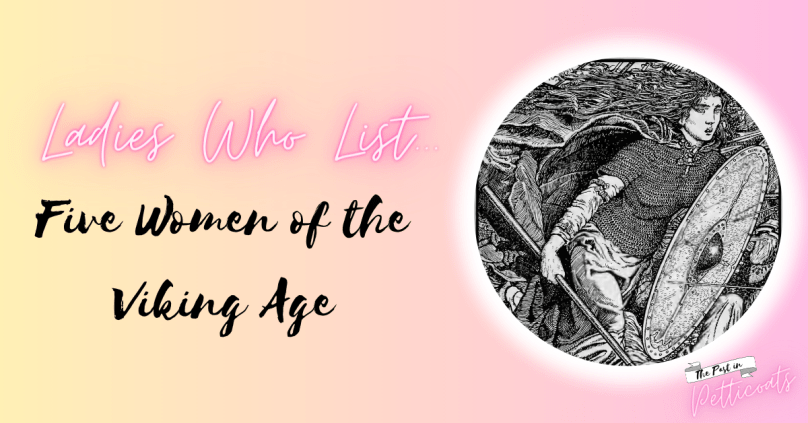
Ladies Who List: Five Women of the Viking Age

The Viking Age occurred in the Early Middle Ages when the Norse people of Scandinavia journeyed out in search of new lands. Those who set sail were called the Vikings and through acts of piracy and war, they invaded countries across Europe. Still to this day, the Vikings are infamous for their ferocious ways and widespread clans. However, the Vikings weren’t all long-bearded men in pointy hats, so, who were the women of the Viking Age?  

1. Freyja

Let’s start with the mythology of the day. The Vikings practiced Paganism and worshipped the Norse gods, this includes Freyja, goddess of love, fertility and magic. In Norse mythology, Freyja is a völva, a magician who uses seiðr, a shamanistic type of magic that sees the practicer putting themselves into a trance-like state where they can access knowledge and see the future. Remember the völvur because we’ll circle back to them later. Freyja was also believed to be married to Odin and rode around on a carriage pulled by cats. Another fun fact about her is that her name is etymologically linked to ‘Friday’.

2. Lagertha

The existence of Lagertha is often disputed. She was included in Danish historian and writer, Saxo Grammaticus’, history book, Gesta Danorum, and all tales surrounding her stem from this one account. In the book, Ragnor Lodbrok, a legendary Viking king, becomes besotted with Lagertha after seeing her fight in battle. He claims her for his wife and she bears him three children. They eventually split and she remarries but she continues to aid her old partner in battle, before returning home to slay her husband and steal his title. She is now best-known for being a main character in the TV show, Vikings.

3. The Seeress of Fyrkat

In 1954, during an excavation at the Fyrkat fortress in Denmark, the grave of a seeress was discovered. It was clear the grave was for someone important due to the conditions the body had been left in. The woman was buried in the body of a horse drawn carriage and she wore a dress of blue and red with gold thread. However, it was three very peculiar items in the grave that point to her profession. The grave contained an iron and bronze wand, a silver amulet in the shape of a chair and a packet of henbane seeds. In the Viking Age, a seeress, (or völva, like Freyja) would put herself into a trance-like state that would allow her to make predictions. The silver amulet likely represents the seats that seeresses would carry with them to use when in their trance and henbane seeds, when burnt, produce a hallucinogenic smoke that could be used to create the trance itself. Although both men and women could practice this form of magic, it was most closely associated with women. 

4. Freydís Eiríksdóttir

Freydís Eiríksdóttir is believed to have been the daughter of Viking explorer, Erik the Red, and born in Iceland in the late 900s. Most details about her life come from two Icelandic sagas that detail her travels with her father and brother, Leif Erikson, to Greenland and possibly even Newfoundland. Her brother is thought to be the first European to set foot on American soil 500 years before Christopher Columbus. In both sagas, Freydís journeys to Vinland, a coastal land of North America, but the details beyond that are very different. In the Saga of the Greenlanders, Freydís falls out with two members of her crew and she plots with her husband to kill them with Freydís herself murdering five women. However, in the Saga of Erik the Red, Freydís is just as ferocious but in this instance she is portrayed as a hero. When native people attack the settlement, an eight-month pregnant Freydís grabs a sword and, bare-breasted, fights the attackers and survives the battle.

5. Olga of Kiev

Now a symbol of Ukrainian courage and defiance, Olga of Kiev was born into a Viking family before being married to Igor of Kiev, ruler of Kievan Rus’, an early Middle Ages territory which covered parts of modern day Ukraine, Belarus and Russia. When Igor demanded expensive tribute from the Drevlians, a Slavic tribe, they murdered him and the crown passed to Olga and Igor’s son, Svyatoslav. Since he was a child at the time, Olga ruled as his regent and she set about a detailed plot to avenge her husband’s death. Her four-step revenge plan went a little like this:

1. She invited some Drevlians to her home, tricked them into falling into a trench and buried them alive. 

2. She invited even more of them to her place (obviously they were unaware of what had happened to the first lot), treated them to a trip to a bathhouse, then bolted the doors and burned the building down.

3. She went to the spot where her husband was killed and organised a funeral feast, waited until the Drevlians had gotten drunk and then had her soldiers massacre them.

4. Lastly, she turned her attention to the remaining Drevlians in their city, Iskorosten, and told them to release three pigeons and three sparrows from each household as a symbol of peace. Then, she had her army tie a sulphur band to each bird’s leg, set the sulphur on fire and send them back into the city until every house was on fire. 

So, er, moving on from that. Olga is also revered as a saint of widows and converts in Catholicism and Eastern Orthodoxy after her efforts to bring Christianity to her people. 

So, there you have it, the stories of five very different Viking women. From saints to slayers to goddesses, voyagers and seeresses, Viking women were a truly fascinating and varied lot. 

Header illustration of Lagertha by Morris Meredith Williams