

TPIP Profiles #6: The History Lover and Maker, Halet Çambel  

Name: Halet Çambel

Born: 27th August 1916

Death: 12th January 2014

Country of Origin: Turkey and Germany

In a nutshell: The history-loving Halet Çambel is one of Turkey’s best-loved archaeologists for her strive to preserve the country’s key archaeological sites. She was also the first Muslim to compete in the Olympic Games in 1936. Oh, and she snubbed Hitler while she was there, she really couldn’t be more iconic. 

*********************************** 

Not every trailblazer knows they’re on the right side of history when they’re living through it but I like to think Halet Çambel knew exactly that when she famously turned down a meeting with Adolf Hitler at the 1936 Olympic Games. But, let’s back up a bit. 

Halet was born in Berlin to Hasan Cemil Çambel and Remziye Hanım in 1916. Her father had links to Mustafa Kemal Atatürk, the much revered and highly respected first president of Turkey. One of the many key social reforms Atatürk championed was women’s suffrage and he granted women the vote during his presidency. Halet returned to Istanbul to study and fell in love with history. She decided to study archaeology at university in France and took up fencing after reading books about knights. 

It was her skills in fencing and the new freedoms granted to women in Turkey that allowed Halet to journey back to Germany for the 1936 Olympic Games where she became the first Muslim woman to compete in the Games. 

By this time in history, the Nazi party was in power in Germany and though the worst was yet to come from the Nazi regime, snippets of what lied ahead were already starting to show. For example, this was the Games were Jesse Owens, one of the greatest athletes of all time, won four gold medals yet was denied a hand shake from Hitler due to his black skin. 

So, when Halet and fellow fencer, Suat Fetgeri Aseni Tarı, were invited to introduce themselves to Hitler, they both refused on political grounds. Halet later said she wouldn’t even have gone to compete in the first place if the Turkish government hadn’t asked her to.

However, it’s not just her sporting career and snubbing one of history’s most horrific individuals that makes her name hit the history books. She was also a vocal advocate for preserving Turkey’s history and archaeology sites. She worked on Karatepe, a Hittites fortress, alongside German archaeologist Helmuth Theodor Bossert. The Hittites were Anatolian people who built an empire all the way back in the second millennium BCE. In her role, she took part in deciphering Hittite hieroglyphics. 

That’s not all though. She also campaigned for the artefacts of the site to remain in place and for the site to be established as an open air museum. She fought for the preservation of archeological sites in Turkey by the Ceyhan River and came to be one of Turkey’s top archaeologists. 

Halet married poet, journalist and architect, Nail Çakırhan, and they stayed by each others’ side for 70 years until Çakırhan’s death in 2008. Halet herself died just a few years later in 2014. 
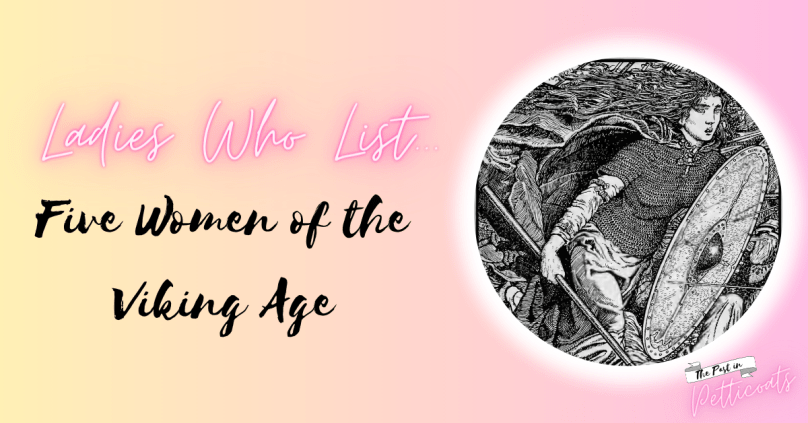
Ladies Who List: Five Women of the Viking Age

The Viking Age occurred in the Early Middle Ages when the Norse people of Scandinavia journeyed out in search of new lands. Those who set sail were called the Vikings and through acts of piracy and war, they invaded countries across Europe. Still to this day, the Vikings are infamous for their ferocious ways and widespread clans. However, the Vikings weren’t all long-bearded men in pointy hats, so, who were the women of the Viking Age?  

1. Freyja

Let’s start with the mythology of the day. The Vikings practiced Paganism and worshipped the Norse gods, this includes Freyja, goddess of love, fertility and magic. In Norse mythology, Freyja is a völva, a magician who uses seiðr, a shamanistic type of magic that sees the practicer putting themselves into a trance-like state where they can access knowledge and see the future. Remember the völvur because we’ll circle back to them later. Freyja was also believed to be married to Odin and rode around on a carriage pulled by cats. Another fun fact about her is that her name is etymologically linked to ‘Friday’.

2. Lagertha

The existence of Lagertha is often disputed. She was included in Danish historian and writer, Saxo Grammaticus’, history book, Gesta Danorum, and all tales surrounding her stem from this one account. In the book, Ragnor Lodbrok, a legendary Viking king, becomes besotted with Lagertha after seeing her fight in battle. He claims her for his wife and she bears him three children. They eventually split and she remarries but she continues to aid her old partner in battle, before returning home to slay her husband and steal his title. She is now best-known for being a main character in the TV show, Vikings.

3. The Seeress of Fyrkat

In 1954, during an excavation at the Fyrkat fortress in Denmark, the grave of a seeress was discovered. It was clear the grave was for someone important due to the conditions the body had been left in. The woman was buried in the body of a horse drawn carriage and she wore a dress of blue and red with gold thread. However, it was three very peculiar items in the grave that point to her profession. The grave contained an iron and bronze wand, a silver amulet in the shape of a chair and a packet of henbane seeds. In the Viking Age, a seeress, (or völva, like Freyja) would put herself into a trance-like state that would allow her to make predictions. The silver amulet likely represents the seats that seeresses would carry with them to use when in their trance and henbane seeds, when burnt, produce a hallucinogenic smoke that could be used to create the trance itself. Although both men and women could practice this form of magic, it was most closely associated with women. 

4. Freydís Eiríksdóttir

Freydís Eiríksdóttir is believed to have been the daughter of Viking explorer, Erik the Red, and born in Iceland in the late 900s. Most details about her life come from two Icelandic sagas that detail her travels with her father and brother, Leif Erikson, to Greenland and possibly even Newfoundland. Her brother is thought to be the first European to set foot on American soil 500 years before Christopher Columbus. In both sagas, Freydís journeys to Vinland, a coastal land of North America, but the details beyond that are very different. In the Saga of the Greenlanders, Freydís falls out with two members of her crew and she plots with her husband to kill them with Freydís herself murdering five women. However, in the Saga of Erik the Red, Freydís is just as ferocious but in this instance she is portrayed as a hero. When native people attack the settlement, an eight-month pregnant Freydís grabs a sword and, bare-breasted, fights the attackers and survives the battle.

5. Olga of Kiev

Now a symbol of Ukrainian courage and defiance, Olga of Kiev was born into a Viking family before being married to Igor of Kiev, ruler of Kievan Rus’, an early Middle Ages territory which covered parts of modern day Ukraine, Belarus and Russia. When Igor demanded expensive tribute from the Drevlians, a Slavic tribe, they murdered him and the crown passed to Olga and Igor’s son, Svyatoslav. Since he was a child at the time, Olga ruled as his regent and she set about a detailed plot to avenge her husband’s death. Her four-step revenge plan went a little like this:

1. She invited some Drevlians to her home, tricked them into falling into a trench and buried them alive. 

2. She invited even more of them to her place (obviously they were unaware of what had happened to the first lot), treated them to a trip to a bathhouse, then bolted the doors and burned the building down.

3. She went to the spot where her husband was killed and organised a funeral feast, waited until the Drevlians had gotten drunk and then had her soldiers massacre them.

4. Lastly, she turned her attention to the remaining Drevlians in their city, Iskorosten, and told them to release three pigeons and three sparrows from each household as a symbol of peace. Then, she had her army tie a sulphur band to each bird’s leg, set the sulphur on fire and send them back into the city until every house was on fire. 

So, er, moving on from that. Olga is also revered as a saint of widows and converts in Catholicism and Eastern Orthodoxy after her efforts to bring Christianity to her people. 

So, there you have it, the stories of five very different Viking women. From saints to slayers to goddesses, voyagers and seeresses, Viking women were a truly fascinating and varied lot. 

Header illustration of Lagertha by Morris Meredith Williams

TPIP Profiles #2: Enheduanna (Poet, Princess and Priestess)

Name: Enheduanna

Born & Died: 23rd Century BCE

Country of Origin: The city of Ur in modern day Iraq

In a nutshell: Enheduanna was a poet, princess and priestess whose particular claim to fame is being the writer of the oldest texts by a named author in world history. That’s kind of a big deal, right?! 

************************************

Enheduanna lived in the city of Ur (in modern day Iraq) in Mesopotamia all the way back in the 23rd century BCE. That’s an almost mind-bending length of time ago so what makes her iconic enough for her name to have made it through the centuries to now? Well, here’s a little known fact. The oldest texts by a named author in history were written by a woman. I can’t be the only one a little bit chuffed about that!

This woman was Enheduanna, a poet, princess and priestess of the Akkadian Empire and from all those alliterative jobs she had (in the English language anyway), it’s clear she was a busy woman. Or, at least, I’m pretty sure she’d qualify as a #girlboss by today’s standard. 

Enheduanna was the daughter of King Sargon of Akkad, the first leader of the Akkadian Empire and possibly the world’s first ever emperor so this pretty epic girl had a pretty epic lineage. Little is known of her family life or childhood but what is known is that she was given a place of great honour in her position as high priestess of the cult of Nanna. Both patron to the city-state of Ur and god of wisdom, Nanna was a moon deity worshipped in Mesopotamia. However, Enheduanna’s poems show a particular devotion to Nanna’s daughter Inanna, goddess of love, beauty, sex and war. For reference, the Greek equivalents of Inanna are thought to be a combination of Aphrodite and Athena. 

Enheduanna’s position as high priestess continued through the reigns of her brothers Rimush and Manishtushu. However, one of her poems, The Exaltation of Inanna, details her enforced exile by someone known as Lugalanne, a possible enemy of her nephew Naram-Sin. I need to pause to tell you a little bit about Naram-Sin as he is an odd figure in history. He is considered the ruler of the Akkadian Empire when it was at its strongest and defied himself so that he not only held the title of king but also god of the four corners, as in the four corners of the world… essentially Naram-Sin classed himself god of the entire world. Aim high, I guess. 

Back to Enheduanna though as we need to talk more about her writing. She wrote several poems and 42 hymns and these had such a lasting impact that she practically set the bar for religious writing, and just about any writing really, for centuries to come. Some even believe the her lasting influence can be found in the Old Testament and the writings of Homer. 

All knowledge of Edheduanna seemed lost to time until 1927 when British archaeologist Sir Leonard Wooley discovered a disk that held both Enheduanna’s name and a carving of her likeness. I’d love to tell you more about one particular member of Sir Wooley’s excavation team, his wife, Katherine, who inspired an Agatha Christie character, but that’s a story for another time. 

As both high priestess, an incredibly powerful and respected position for her time, and poet, Enheduanna made her lasting impact on history. It’s also worth noting the impact she had on literature. The very first uses of written language date way back to ancient Mesopotamia three thousand years BCE. However, the written word came in the form of note taking for the merchants of the time to keep track of their finances and dealings. Enheduanna was the individual that took written language away from being a tool of necessity and turned it into a means of self-expression and worship. So, to answer my own question from the beginning, yeah, Enheduanna and her impact on literature is definitely a big humungous deal.

Thank you for reading. Just a little disclaimer that I’m not very familiar with the history of Mesopotamia but I’ve done my best with researching on this because it was a story too good not to tell. If any of the facts are a little off, please feel free to let me know. For more info on Enheduanna and her influence, check out this amazing TED-Ed video.